
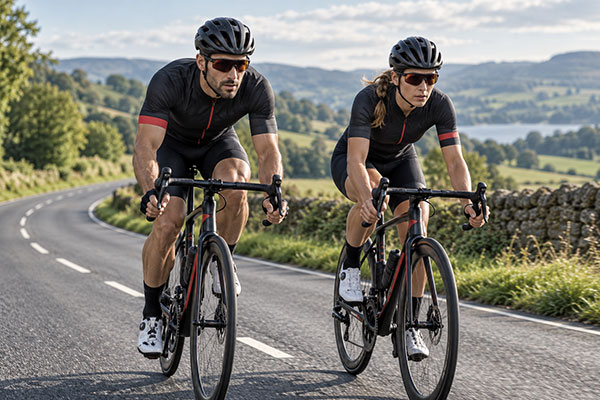
It’s a question we often hear at training camps, during coaching calls and on start lines: are men and women really that different in cycling?
The honest answer?
Yes, in certain physiological metrics. But no, when it comes to commitment, progression or the potential to perform at the highest level within their category.
The Physiology: What Actually Differs?
From a biological standpoint, male and female athletes do differ in several key areas. On average, men tend to have:
- Greater total muscle mass
- Higher haemoglobin concentrations
- Greater potential cardiac output
- Higher absolute VO₂max values
This typically translates into higher absolute power outputs — essentially, more watts on paper.
However, cycling performance isn’t decided by watts alone. When we consider relative power measured in watts per kilogram (W/kg), lactate threshold as a percentage of VO₂max, fractional utilisation and durability over time, the gap narrows considerably.
The Performance Science
1. VO₂max and Oxygen Delivery
Men often record higher absolute VO₂max values due partly to differences in cardiac size and haemoglobin levels. However, elite female cyclists can demonstrate extremely high fractional utilisation, meaning they can sustain a large percentage of their VO₂max for prolonged periods.
In practical terms, this allows female athletes to produce exceptionally strong and sustained threshold efforts.
2. Substrate Utilisation
Research suggests that female athletes may rely more heavily on fat oxidation at submaximal intensities. This can be advantageous during long endurance events, where metabolic efficiency becomes increasingly important.
It is something we emphasise heavily during base training, as developing this efficiency can become a powerful asset for an endurance cyclist.
3. Fatigue Resistance and Durability
Durability — the ability to maintain power output deep into an event — is becoming one of the most important measures in modern cycling science.
Emerging evidence suggests that women can demonstrate strong fatigue resistance during steady-state endurance work. In races where positioning, pacing and repeatability matter more than one maximal surge, this becomes highly relevant.
4. Hormonal Considerations
One area in which coaching must become more individualised is hormonal variation.
Men generally operate with relatively stable testosterone profiles. Women experience cyclical hormonal changes that can influence:
- Perceived exertion
- Recovery rate
- Core temperature
- Substrate use
- Neuromuscular coordination
This doesn’t mean women are at a disadvantage. It means coaching needs to be informed, responsive and based on the individual athlete.
At Ride Revolution, that can involve:
- Adjusting training intensity when appropriate
- Prioritising effective fuelling strategies
- Encouraging open communication
- Monitoring individual recovery trends rather than relying on assumptions
The underlying training principles remain the same, but their application should always be individual.
The Tactical and Psychological Reality
Cycling isn’t performed in a laboratory. It is raced on open roads, where decision-making, positioning, confidence and tactical awareness can all become major performance multipliers. These are not gendered traits.
Modern women’s racing has built a reputation for being relentlessly aggressive, unpredictable and dynamic. The growth of the Tour de France Femmes has demonstrated just how deep and competitive the field has become.
The standard is rising rapidly because the structure surrounding women’s cycling is improving.
The Bigger Difference: Opportunity
Historically, the largest gap hasn’t necessarily been physiological. It has been a gap in:
- Investment
- Media coverage
- Sponsorship
- Development pathways
When opportunities expand, performance follows. We are now seeing:
- Stronger domestic women’s fields
- Greater visibility
- Higher training standards
- Better access to professional coaching
The results speak for themselves.
So, Is There Really a Difference?
Yes, when looking at average absolute physiological metrics.
No, when it comes to commitment, resilience, tactical intelligence or the ability to progress through structured coaching.
Ultimately, cycling performance is built through:
- Aerobic development
- Progressive overload
- Intelligent intensity distribution
- Recovery discipline
- Confidence and belief
Why This Matters at Ride Revolution
Good coaching isn’t about treating every rider identically. It is about understanding physiology, applying performance science intelligently and adapting the training process to the individual.
Our role is to:
- Understand each rider’s physiology
- Apply performance science intelligently
- Create a supportive training environment
- Encourage and support ambition
- Build sustainable, long-term development
The growth of women’s cycling isn’t a side story within the sport. It is one of the most exciting performance evolutions happening right now — and as the race season unfolds, that is something worth celebrating rather than comparing.
Cycling doesn’t reward gender; it rewards preparation. We’re here to prepare every rider, whoever they are, to perform.